Those who cannot remember the past are condemned to hear people repeat that those who cannot remember the past are condemned to repeat it and man those people are annoying.
And then this from the esteemed Dr. Willburger on Twitter:
“Roman flask in the form of a fish was found in La Dent, Meyzieu, Rhône, France. The neck is in the place of the dorsal fin. We don’t know what the flask was used for, maybe the shape relates to the content (garum – fish sauce), maybe it was used to hold oil or perfume.” It’s from the Third Century (that is, between AD 200 and 300), she adds.
Those were rough years for the Roman Empire. The “Crisis of the Third Century” saw invasions from Germany and points east that were incredibly destructive. By the time Roman arms were able to restore order towards the end of the century, great swathes of the Gaul and the Balkans had been laid waste, you can just imagine how many fine pieces like this were shattered. So it’s nice to see this one quite intact.
Oh—that garum, or fish sauce. The Romans empire-wide were mad about garum. They produced it on a nearly industrial level, in huge vats on sites that could cover acres, basically fish sauce factories. The stink of rotting fish must have been astonishing. It was poured into shipping containers and sent via sea or river all over the Empire, and nearly every wreck of a Roman vessel discovered lying on the sea bottom is full of jars of the stuff. I’d always thought garum must’ve been the most revolting thing imaginable till it occurred to me my beloved bottle of Worchester Sauce is a nineteenth century English recipe for garum. When I sauté a mess of veggies (always lots of green onions) in olive oil splashed liberally with Worchester sauce I’m preparing a simple meal almost as old as Western Civilization itself, right down to the bread torn from the loaf and glass of red wine.
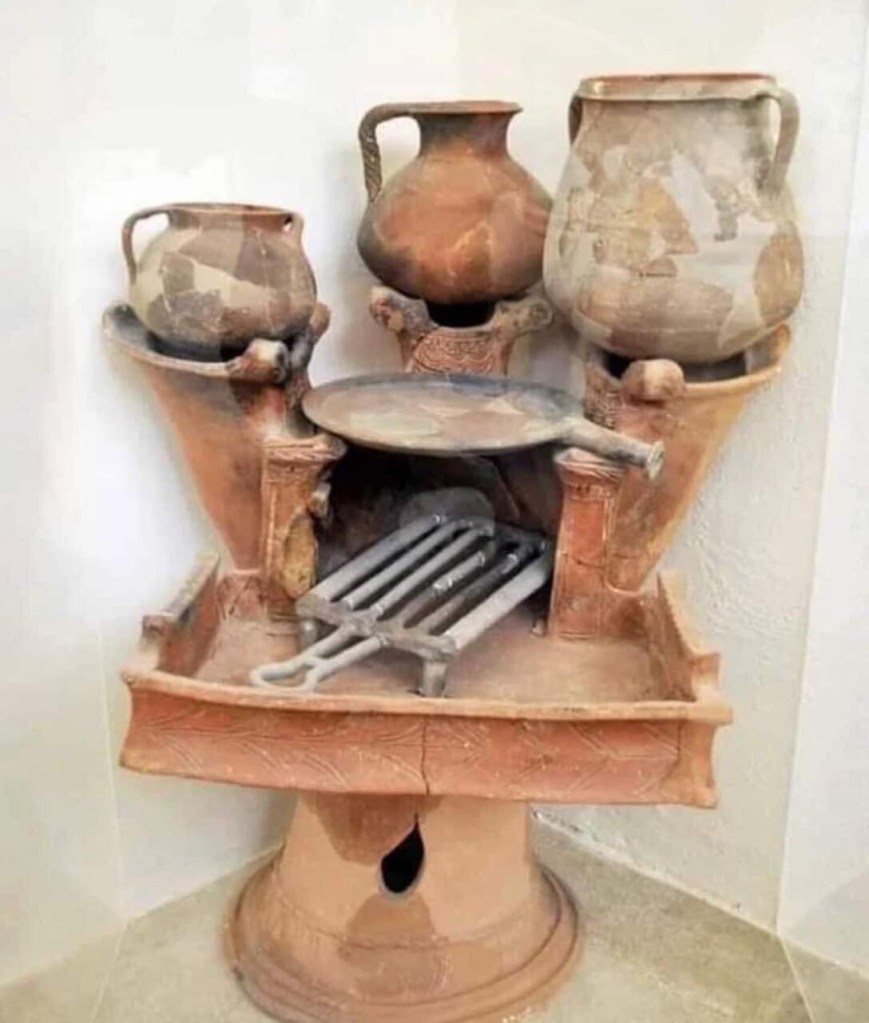
From a tweet from the Archaeological of Delos: “A 2,500 year old ancient Greek ‘cooker’: three (or four) stoves, oven and a grill. Found on the Greek island of Delos.” That’s all it said, plus the fabulous picture below.
But 2500 years ago Delos was going through some changes, as they say. It was a major Greek religious center (I know Apollo was worshiped there), and right about this time the island tyrant got into a purification thing and ordered all gravesites within view of the temple to be moved. A century later in the midst of the Peloponnesian War it was ordered that all human remains be moved off the island, then dying on the island itself was prohibited, and giving birth on the island as well. Finally all the people were removed, and Delos was sat there in the Aegean sun, empty of everything but birds and temples and the shadowy movements of the gods. It had to the most purified island ever. Not sure how long that lasted. By the time the Romans took the place a couple centuries later, people were back, living and dying and being born just like they were on any other Greek island. But right about the time people were serving up meals on this tiny kitchenette, it was getting weird for the locals.
From Tutankhamen’s tomb, a 3,350 year old board game. I’ve no idea if archeologists or historians know how it was played (it was probably a lot more complex than it looks), but damn, what a beautiful 3,350 year old thing. The not so beautiful but ginormous pyramids at Giza are 4,500 or so year old things. Egyptian civilization got a little more intricate and delicate with age, it seems. 1200 years ago was just as long ago and different to people 3,350 years ago than it is to us now, when 1200 years ago was 970. Eek. And not to change the subject, but those gorgeous hieroglyphs all over this object had reached their apogee about this time, really been perfected into a technology that could express stories. The spoken language had changed dramatically from the language spoken 1200 years earlier by the pyramid builders, as all languages do, but I imagine the written language of the pyramid builder’s time could be read by thise who could read in Tutankhamen’s court (though not vice versa, as hieroglyphics by King Tut’s time had all kinds of things still undeveloped 1,200 years earlier.) But I’m digressing from the whole point of this post, which is what a beautiful thing this is. And was, as I’m sure it was just as lovely 3,350 years ago as it is now.
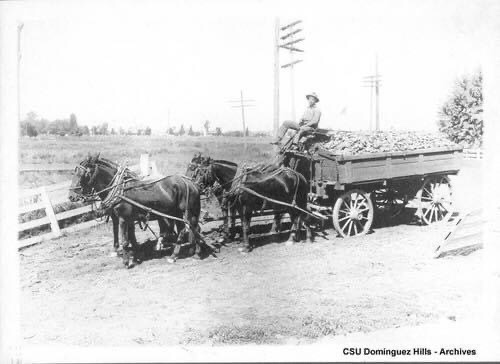
A photo from Compton, California, a now completely urbanized community on the city limits of Los Angeles, back in 1910. Indeed, most of flatland LA and environs was farms, orchards, vineyards and cattle pasture well into the 20th century. As farmers sold out to developers the city would often end on one side of the road and fields begin on the other side. When I was a kid in Orange County in the sixties and seventies, the entire area was a patchwork of intense development and farmland. One year there’d be strawberry fields and orange groves, a year later there’d be a new housing tracts, a shopping center, a freeway, a mini-mall (I don’t think they called them mini-malls yet, though), an amusement park. Disneyland still had strawberry fields across the street. My folks finally bought a place way the hell out in Brea, which was like the edge of the world in 1971, and our tract had been cow pasture—maybe cattle land would be a better description—just a year or two earlier. The cows were gone, but the flies remained. There were still lots of cattle across the road, we’d pass by herds of the beasts on the way to Brea Olinda High School. All the kids had stories about running for their lives chased by an angry snorting bull. A few years later not even the flies remained. It was solid suburban tract homes. In the early seventies, though, Brea Olinda High was still rural enough thst it had a farm right on campus, and the Future Farmers of America kids drove their cows and hogs, goats and sheep across campus, the long haired suburban kids jeering and laughing. They got the last laugh, too, those jeering suburban kids, the farm was closed a few years later as the last pastures and groves in the area were plowed up and houses and a new mall put up in their place. Last time I was in Brea I got lost. I was going to show Fyl where we’d first lived in a rental across from a park, and sometimes we’d walk home from Brea Junior High through downtown Brea, a stretch of Midwest farmtown on the fringes of Orange County suburbia, a world away from Surf City USA. But the two lane road between pastures was now a six lane river of asphalt, and every last thing I remembered was gone. Only the street names remained.
A wagon load of sugar beets in Compton, 1910. Source: California State University, Dominguez Hills, Archives and Special Collections. Thanks to Los Angeles Relics on Facebook for posting this picture and inspiring this essay.
Hollywood in 1903. The picture is looking from Whitley Heights, which is the hilly section you pass through on the Hollywood Freeway on your way into the Cahuenga Pass, just before you see the Hollywood Bowl. If you’re coming south on the Hollywood Freeway (the 101) this is the view that opens up a moment (or an hour on a bad traffic day) after passing by the Hollywood Bowl. It’s just that almost nothing you see now was there in 1903. The wider road running horizontally across the picture would be Hollywood Blvd (called Prospect Avenue then) which already had street car tracks running down its center. I’m not sure what street it is running diagonally through the picture, the beginnnings of Cahuenga Blvd? And did that road running along the base of the hill become Franklin Ave? Sunset Blvd is just discernible beyond. Even this early you can see that Hollywood Blvd (Prospect Ave doesn’t quite have the same ring) was more crowded with bigger buildings than Sunset Blvd. It’s a discombobulating view here, as so little of pre-studios Hollywood still stands and aside from Hollywood Blvd itself nothing is familiar in this photograph. Within twenty years this would be dramatically transformed, though, and within thirty it would look like a city.
Saw this posted at the wonderful Los Angeles Relics page on Facebook.
A lot of Iranian foreign policy is driven by the history of the various Persian empires that have existed in a continuous arc for three thousand years. Iranian civilization today is the direct descendant of Persian civilization three millennia ago. Persian civilization never disappeared, was never destroyed and reborn, it’s perhaps the oldest continuous civilization in the world. Persia has been playing this game in Iraq and Syria for thousands of years and are very aware they have been doing so.
We are not. We will never. We can’t even begin to fathom what is going on. Iraq is a lattice of grudges going back to the very dawn of civilization, grudges that last for centuries, for eons, grudges so old people’s don’t even know why they hate other peoples except that their ancestors did, and those ancestors never questioned why either. Civilization doesn’t mean everyone gets along. Put a few thousand years of lots of civilizations in one relatively small area and you get quite a beautiful mess. Humanity thrives on conflict. Otherwise we’d be like the Neanderthals, scarcely changing in a hundred thousand years, peacefully using the same flint tools for 5,000 generations. But look what Homo sapiens have achieved in a mere 500 generations of civilization in the Middle East. A lot of rich history, a lot of extraordinary cultures, a lot of endless fighting. But with drones now, no stone tools.
In the long sweep of the history of the Middle East, our Iraqi intervention will scarcely be noted. We we there and then we were gone a couple decades later, and we made no difference whatsoever.
A Roman glass bowl found perfectly preserved in Nijmegen, Netherlands. I doubt it was produced locally, though who knows. There might well have been Roman glass workers there. Batavia (as they called the Netherlands then) was on the northern fringe of the Roman Empire when the empire was at its apogee, and was a trading center, and Roman items reached all the way there via trading vessels, that is aboard ships, which is difficult to imagine now, traveling from the Mediterranean to the North Sea in those ancient ships. Even getting to Holland from the Atlantic coast of France seems extraordinary. They’d trade Roman finery and jars of rancid fish sauce (the ancients loved their rancid fish sauce) for timber and furs and amber. (The exciting things you learn when you read too many big, dull books….) Unfortunately the source document is in Dutch so I’ve no idea of the details, and the Twitter thread quickly degenerated into a series of jokes about the box, and so I haven’t a clue how such a gorgeous thing was preserved in perfect condition since at the latest the 300s although if I had to guess I’d say it was found in a bog. Otherwise not much Roman glassware survived the inebriated depredations of hirsute barbarians who never bathed. Oddly enough, though, I’m looking at a bowl we received as a wedding present not quite in the 300s that bears a remarkable similarity to the design of this one. I‘d no idea it was based on a Roman design, I assume the pattern has survived into modernity via the Byzantines. Now it’s hidden under the coffee table full of assorted junk. How it’s survived all the decades of increasingly less hirsute inebriated depredations in our pad is almost as much of a mystery as the two thousand year old Roman bowl. Such is the fate of civilization.
Aside from a dozen or so shells from the deck cannon of a Japanese sub that dId little damage to an oil field outside Santa Barbara, and a few hundred Japanese balloon bombs that started a small number of fires and killed a mother and five children in the northwest (versus the third of a million or so Japanese civilians killed by US bombings in 1945), the Japanese were never able to strike the west coast with anything at all, no air raids, no shelling. The Germans didn’t even manage that. Their U-boats sank ships within sight of the east and gulf coasts, but none ever took shots at anything on land. Planned long range bombers by the Japanese and Germans came to nothing. Americans got off very lucky, with just about every other belligerent in the war bombed by somebody, but aside from Britain no other country but the US thought that big four engine bombers would be of much use. There was no Nazi or Japanese B-17, and the Germans lost the war before they were able to construct a V-2 type rocket bomb that could cross the Atlantic or build a nuclear weapon for it to carry. Not that they weren’t working on it. The Japanese version of the bomb never even got past the conceptual stage. One gets the impression that neither the Japanese nor Hitler had thought this war thing out too clearly.
But we didn’t know any of that in 1941. Like Hitler’s Blitzkrieg, the Japanese army and navy seemed quite invincible for a while. It was assumed that flights of Japanese bombers would appear over Los Angeles (or San Francisco or San Diego), or the same carrier planes that surprised the sleepy sailors and soldiers in Hawaii on December 7 would appear unexpected about the west coast, or an armada of Japanese battleships would come out of the fog off a few miles off Long Beach firing enormous shells which could hit as far downtown LA. The Coast Artillery would fight it out with the battleships (you can see where the enormous cannon of the U.S. Coast Artillery were installed at Fort MacArthur above San Pedro). But there wasn’t much anybody could do to stop those big four engine Japanese bombers, which didn’t exist, though we couldn’t be sure of that. And we could have lost the Battle of Midway, all our carriers sunk instead of theirs, and the Japanese could sail a fleet of them up to the California coast and attack Los Angeles like they had Pearl Harbor. Sounds ridiculous in hindsight, but it was considered feasible to nervous planners then. War was on, unimaginably, and suddenly everyone on the West Coast was scared shitless.
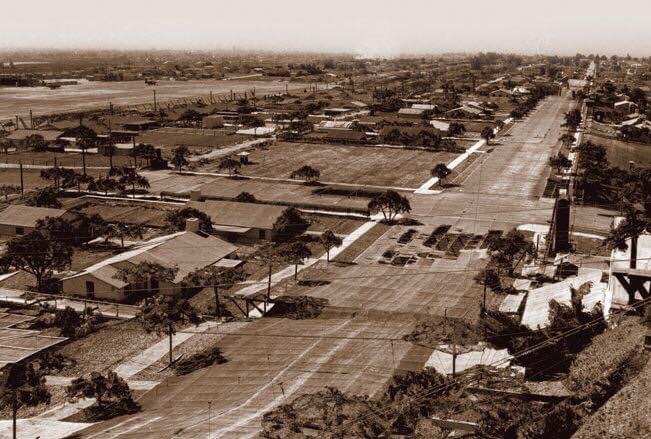
So civil defense authorities and jumpy officials in the Pentagon ordered construction of vast camouflage netting to conceal acres and acres of aircraft manaufacurers and other vital facilities, and like magic entire suburban neighborhoods and parks and meadows instantly appeared, and large parts of America’s war effort looked as unbombworthy as a sleepy distant suburb. Meanwhile, invisible to anyone in a cockpit of a bomber a mile high, planes at this particular Douglas plant in the photo were produced by the thousands, part of the hundred thousand or so aircraft produced by Americans during the war. It was an enormous art project, really, all this camouflage, and doubtless all sorts of artists (especially movie studio artists and set designers) suddenly found themselves classified as essential war workers and couldn’t be drafted as they were needed to create non-existent suburban neighborhoods nobody in their right mind would waste a bombload on.
I wonder if it was considered as weirdly cool and beautiful back then as it seems now. Did Rosie the Riveter admire the billowing cover overhead aesthetically? Or was it just another crazy war thing? Everything must’ve seemed crazy by that point. And then the war ended, the covers were taken down, rolled up and stored somewhere, forgotten. Nuclear bombs had made the whole idea kind of silly anyway. They incinerated city and suburbs alike, no respect for art.
The camouflaged Douglas factory in Santa Monica, 1945.
The reign of Queen Elizabeth saw the complete disintegration of the British empire, the mighty Royal Navy reduced to a handful of ships, Scotland on the verge of leaving the United Kingdom and London’s financial center moving to the continent. Only the collapse of the Soviet Union rivals it in great power failure. Yet the monarchy continues in pomp like it still rules half the globe. People fete her like these past seventy years have been a royal triumph. Imagine trying to explain this to Queen Victoria. Two fifths of the world, willingly or very unwillingly, was under her rule. Elizabeth has a fractious Britain, a chunk of Ireland, a smattering of mostly tiny islands about the globe, and Canadians, Australians and New Zealanders who just can’t seem to part with Dear Olde Mum. Glorious indeed. I don’t get it. Must be an English thing.
1500 years ago a 12 year old girl near Basel, Switzerland was buried with hundreds of these beads and trinkets. They wouldn’t have had much value then, the area was formerly Roman and the economy still used lots of old Roman coins as currency as well as their own coinage, items like these were strictly for costume jewelry or sewn into garments. The girl probably just liked them and collected them. Basel is on the Rhine, the Danube was not far off, the Rhône only a bit further, and every summer Switzerland was alive with merchants, traders and tinkers who passed back and forth through the Swiss passes bearing all sorts of thinks to sell and swap. The amber would have come all the way from the eastern Baltic and brought to Basel by some network of rivers and trails. Things travelled far back then when wars and plagues didn’t interfere, which, alas, in those dark ages, happened far too often. But still, we can imagine her spreading these treasures out on a skin and picking out shiny pieces to peer through into the fire and see things we don’t see, ghosts and spirits and the souls of the deceased. Those were different times, and the Neolithic imagination wasn’t yet completely purged from the minds of the peoples who came west from the vast plains and mountains of central Asia to sweep away the Roman Empire. Shadows still played on walls and fires flickered with beings we can’t see all around us.






 Brick's History