Cahuenga Parkway

Traffic on the Cahuenga Parkway in 1945. It was only a mile and a half long, it didn’t go the rest of the way into the San Fernando Valley until 1954 (by then it was called the Hollywood Freeway.) Doubtless WW2 had thrown the project off schedule. Gasoline was tightly rationed until the Japanese surrendered in August of 1945, and I’m wondering if this photo was taken after then of if there were that many cars on the road even with strict rationing. The speed limit was a strictly enforced 35 mph nation wide until August of 1945, too, so nobody was in too much of a hurry here, and even if they were they couldn’t floor it. Besides, parts were next to impossible to get all war long so drivers tended to coddle their cars so nothing wore out. You’ll notice how you see no really old cars here, as if anyone driving a clunker didn’t dare get on a freeway, well, parkway.

From the highly recommended Freeways of Los Angeles group on Facebook.

Hollywood Blvd, 1904

Heading west (northwest, actually) on Hollywood Blvd just past Sunset Blvd in Los Feliz in 1904. Locals will notice the complete lack of anything they can recognize except the straight line of Hollywood Blvd between Sunset and the yet to be laid down (or even thought up) Vermont Avenue. Twenty years later this would all be urbanized and this picture would be as discombobulating to locals in the 1920’s as it is to locals now, a century later. They’re driving past what will be the VIsta Theater, but movie theaters wouldn’t even be invented till 1905, and in Pittsburgh. And just ahead of them at Sunset Blvd in a mere dozen years will be the vast movie set for the film Intolerance. Try explaining that to the people in that car, how in just a dozen years this hushed little world of orchards and vineyards and flowers will be unrecognizably and completely changed by a technology that scarcely exists yet.

Amazing the things you can see, and the things you can’t see, looking at really old photographs of the places you live.

(Pretty half baked essay, I see now, I managed to make it sound like there were no such thing as film and film making in 1904, when The Great Train Robbery was still playing to big crowds in the Vaudeville houses, hell, the people in the car may have been on their way downtown to go see a movie, who knows. Sunset was the thoroughfare connecting Hollywood and Los Angeles even then. If you were staying at the Hollywood Hotel (opened in 1902) a hour or two drive by motorcar through the lupine covered hillsides down Sunset would be grand entertainment. So people in Hollywood even then knew of films, and knew that there were studios like Edison’s churning them out prodigiously. But they didn’t know movies were about to become big screen huge productions and and entire industry would come into being making them. They certainly didn’t know that it in just a couple years movie making old begin moving from the east coast to Los Angeles. That there’d be a movie studio on Sunset—about a mile and a half from where they were when this picture was taken—in just six years and within a decade there’d be a mess of them. That was the technology I meant that turned a dreamy expanse of orchards and farms and flowered fields into enormous movie studios and a city to go with them. But saying that would take a lot more words than my initial post. Too Long Didn’t Write.)

Glendale, 1895

Corner of Wilson and Glendale Avenues (or Third St. and Crow Avenue as they were called then) in 1895. A cash grocery then meant you couldn’t swap a couple chickens for some molasses. I assume the Glendale Market next door would take your chickens for some gingham for Mary Lou, to cop a line from the Woody Allen live album I virtually memorized back in high school. The tilty roof thing in the back is a barber shop. There’s an underground Ralphs there now, and they won’t take your chickens either. 1895 was right in the middle of the very harsh 1890’s depression, the Panic of 1893 having fucked everything up. Perhaps that explains the cash groceries of the day—there was one in Hollywood too about the same time—there was little cash going around for a few years. I don’t know about Glendale, but political upheaval resulted nationwide as the Depression wore on. William Jennings Bryan and the Cross of Gold he would not be crucified on. The Midwest was a hotbed of radical politics, populists elected everywhere there to everything. Imagine that. Dig the tracks going down the middle of a dusty Glendale Avenue, he digresses.

Glendale Cash Only Grocery and Glendale Market, 1895

Lincoln

A long lost photo of Abraham Lincoln lying in state in the Capitol Rotunda, April 1865. Photographers were banned, I’m not sure how this could have been taken without getting caught. Perhaps the photographer was caught and expelled, but managed to conceal the photo plate. Tens of thousands of grieving people filed past Lincoln’s body for two days, ordinary people and dignitaries, farmers in home spun and big city dandies and emancipated slaves and, once the public viewing was done, long lines of bandaged, hobbling, often limbless soldiers brought in from the hospitals all over Washington. On the third day the body was put aboard a funeral train for the long ride back to Springfield, Illinois, past silent crowds and clusters of people all along the way, where he was laid to rest in a simple grave per his wishes. Sometime later he was reinterred in the towering almost Roman marble monument that would have appalled him and where, deep inside a cavernous and elaborately appointed tomb more worthy of an emperor than a simple country lawyer, a seven ton cenotaph of red marble marks the way to the burial chamber deep down containing the white marble sarcophagus where his bones lie to this day. People file past and speak in hushed voices, and you can almost see him there, lanky, bearded and lifeless, and wonder.

About all those missing words….

Sorry there’s no more of the great gobs of prose I used to spill out all over these blogs. People have been asking. Alas, epilepsy was really fucking with the long essays, a d I finally had to stop. Had to stop working too. Had to stop just about everything. It’s been a couple years now and the synapses have calmed down nicely. They seem to like being bored. Me not so much at first but I’ve adapted. So I write tiny little essays now, scarcely ever longer than a paragraph. Hence all this tinyness where vastness used to be. Little gems, I tell myself. The actual gemage might be debatable, but they’re my blogs. You can think everything you do is art if no one is editing you.

Anyway, thanks for reading and feel free to complain.

Brick

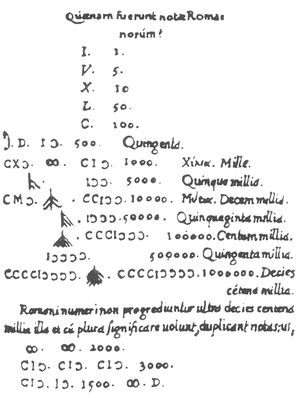
Roman numerals

It’s taken a millennium for Arabic numbers—actually Indo-Arabic numbers—to replace Roman numerals, which cling to use in the Anglo-American world, but just barely. Roman numerals we still call them, because numbers were numerals a century ago. But numerals became numbers since then, while Roman numerals remained numerals, stuck a century ago, when they still retained some of their long dead glory and were used everywhere, on buildings, in footnotes, on clock faces, in the years movies were released. They get harder for us to read each year, too, harder for us to convert them to Arabic numbers in our head. Thus do the vestiges of ancient civilizations disappear.

It was just the opposite when Arabic numbers began to seep into the west in the late Medieval. They confused people, those who could read and write anyway. (You didn’t need to be literate at all to use the rather extraordinary fingering computation method used in the Middle Ages, though it’s certainly beyond me.) They couldn’t quite get the hang of what seems so perfectly natural to us now. There were bastard forms, like MCCCC92, or M4C92, or 14XC92. Worse yet was the creepily mysterious zero, which made no sense at all to most Medieval Europeans—how can something represent nothing?—thus rendering 1390 as, say, X3C1C. Unlike the introduction of the alphabet, which rendered entire literatures written in cuneiform and hieroglyphics unreadable within a couple generations, the switch to Arabic numbers took many centuries. Incredibly it was well into the 19th century that you could find Roman numerals still in daily use throughout the Anglo-American world, which is why, I suppose you can still see them affixed to old buildings or in chapter headings or the fine print of movie credits from the first half of the twentieth century. People refusing to budge from the style guides they learned in college fifty years before. You can just imagine them outraged at kids using Arabic numbers instead of the Roman numerals that had been good enough for Cicero.

But those people retired and died, and Roman numerals began to disappear from just about everything by our time (including time itself, or clock faces anyway.) Just about. The NFL, if not quite reviving the the two thousand and some year old numbers system (with origins in Etruscan numbers several hundred years earlier), has over the last half century managed to put Roman numerals into the consciousness of a couple hundred million viewers every year. Indeed, were it not for the Super Bowl—the Super Bowl, ferchrissakes, that bastion of classicism—the god damned things might have been gone and forgotten by now, except in musty academic circles or on the occasional monument. But everyone can read Roman numerals now, at least up to two Arabic number figures, which I believe would be at maximum six Roman numbers, XXXIII. This year was what, Super Bowl LV? Or as a confused Medieval football fan might have written it, X5V. Go figure.

Converting Roman into Arabic numbers in 1582.

A beautifully limned and muscular Fascism

Finally saw The Prime of Miss Jean Brodie last night. Maggie Smith, gorgeous locations, etc. It seemed a rather nothing story about an incredibly irritating Scottish teacher and her perfect little students. La creme de la creme she called them. She worshipped beauty, art, perfection, punctuality.

It began to get more interesting. A few plot twists and character revelations developed–-lust, weirdness, disturbing intimations of a warped sexuality. Then slowly she revealed a fascination for fascism. First in hints. A mention of Mussolini. A true Roman she told her students. The romantic definition of hero, the Shining Hero, something long since lost to us viewers in war and compromise and threats of nuclear annihilation. Finally she revealed herself as an out and out Fascist sympathizer. She showed the class slides of a holiday in Rome, a plaza full of uniformed Fascisti. She mixed with them, she said. They had excited her. She nearly panted at the memory. She remembered exactly what she’d been wearing. Somehow her own perfect attire had matched their perfect uniforms. That startled me. Fashion and fascism. How her personal Romantic ideal and the massed Fascist Ideal blended perfectly. Their muscularity and her femininity. Her sex, their power. Etc, etc.

Come the Spanish Civil War the man of the hour became Franco. Oh she could go on about Franco. Near to swooning. I felt an automatic revulsion. We forget now that as many westerners supported the Nationalists as supported the Republicans, people like Evelyn Waugh, J.R.R. Tolkien, Salvador Dali, Wyndham Lewis and (of course) Ezra Pound. Even Gertrude Stein. Miss Brodie’s sympathies would not have been so shocking back then. Perhaps not really shocking at all. No more shocking than those enraptured by Stalin, perhaps even less so. Communists promised revolution and purges. Il Duce promised order. Brodie, we are told (by one of her skeptical students), was quite vocal about her sympathies. It became part of her curriculum. The humanities and fascism blending seamlessly. Her creme de la creme becoming perfect little fascists, she hoped.

They didn’t, except for the simple, suggestible one who, swept up in Miss Brodie’s excitement, made for Spain to join her brother fighting for the Nationalists. The poor thing was machine gunned at the French border. Miss Brodie showed little remorse, as the girl had died for the cause, for the new order. A silly eighteen year old girl meeting a glorious death. A heroic death. Hints of ancient Greece. You and I know it was a squalid ugly death, terrifying, an utter waste. In my head I heard her screams. Miss Brodie’s other students, the poor girl’s friends, knew better as well. (Indeed we find out later that the dead girl’s brother was fighting for the Republicans, something that had never occured to Miss Brodie.)

By this point the movie had slowly, subtly turned creepy, a fascinating look into just how high minded intellectuals bought into the Fascist ideology. How Mussolini and then Hitler had so many admirers in England, in Europe, throughout the Western world. And just how insidious a thing it was, this fascism, how it could mix with art and poetry and perfection, co-opt Romantic ideals, send middle class kids off in shiny uniforms to conquer and gas and execute and massacre without compunction, leaving tidy notes of how many were killed that day, how many men, women and children, and the inventory of what they left behind, hats, hair, overcoats, gold teeth.

We think of Nazis as brownshirted thugs, but the SS took the best and the brightest. There were more brilliant minds in the Reichssicherheitshauptamt than ever joined the German resistance, many times more. Fascism in all its forms–-Italian, German, Spanish, Romanian, Hungarian, English, all of it–-was fundamentally an intellectual movement. A middle class movement, rooted in universities. Indeed, deep down it had begun in poetry and art. Italians shocked into a new reality, hard and unyielding, by the lunacy of the Great War. As the old world destroyed itself then, empires fell, monarchs executed, tradition and history tossed out the window, the world seemed  divided between the deary proletarian future of Bolshevism or the beautifully limned and muscular Fascism. I can’t fathom the appeal at all, that thing that sent chills up young fascist spine, made the hair stand up on their arms, rushed the blood to the brain and loins. But you can see it in Miss Brodie, in her prime, remembering the musk of young rippling fascists on parade and taking unsaid fantasies with her to bed that night on a Roman holiday.

It took total annihilation to rid the world of Fascism. We lopped them off like a gangrenous limb. We hung the thugs and the intellectuals by the neck until dead or pulled their lifeless heads out of their kitchen ovens. We shot down Hitler Youth in their suicidal charges. We jailed nazi functionaries for years and put Ezra Pound in a cage. The trials were endless and humiliating, The denazification more so. Hitler shot himself in his bunker to avoid Mussolini’s fate dangling from a meat hook. Only Franco, smart enough to stay out of the War, survived the collapse of fascism, isolated and silent. Fascism as a living, growing ideology was dead.

Or so we thought. Some Nazis escaped and helped keep the idea alive in South America. Peron seemed fascinated by fascist demagoguery, Pinochet goose stepped with the best of them. But that was a more Latin American thing, more Franco than Italian, devoid of Nazi racial theory and efficiency, their armies incapable of anything but parades, torture and repression. But it’s the idea of fascism that remained in Europe. Some strangely replicating meme that grew from the wreckage of fascist empires. That weird, warped romance, the thuggish hero, the big black shiny boots. The websites full of hate and purity and uniforms and alternative history, A reich that will rise again. There aren’t many of these new fascists–they’ve come nowhere near to seizing power anywhere–but they are there, vocal and obvious and scary. In milder form they’ve influenced elections in France. In savage form they’ve made headlines in Greece. They’ve infected football crowds in Italy and even, shockingly, held rallies in Moscow complete with placards of Adolf Hitler himself. I ask myself just how warped a Russian must be to idolize the very man who tried to exterminate them.

Now we’re told that nazi sympathizers pitched in and helped depose the old communist regime in Ukraine, much to the delight of Russian propagandists. If so, that would be the first constructive thing that fascists have done since their post war re-emergence. And what does that mean? I wonder if we’ll ever rid ourselves of the romance of fascism, if it will ever go away. Will it take a generation or centuries? Perhaps, like cancer, it’s built into the very DNA of European civilization, and it will never go away. Perhaps it will even come into intellectual fashion again, with Miss Jean Brodies teaching it to the creme de la creme.

Oh, the movie. It was good. It really was. I thought I was going to hate it, but I couldn’t tear myself away. Maggie Smith was splendid, of course. So were several of the girls. And the artist, though his lechery has not aged well since 1969. The scenery was gorgeous. And if the dialog was oh so precious in too many places, perhaps it might not be to a viewer in Great Britain. At least I told myself so. And yes, it’s utterly ridiculous to reduce a movie review to a tangent on fascism. There was much more going on. I certainly missed the point of the story. But I hadn’t really. It’s just that it was Miss Brodie the fascist that bothered me as I watched the movie. And still bothered me this morning as I drank coffee and listened to the rain, bothered me enough to write this. What an oddly horrible world it must have been where teachers taught fascism with art and etiquette and knew in their hearts they were right.

(Originally posted in 2016 on BricksPicks.com as “The Prime of Miss Jean Brodie”.)

Thoughts on a few seconds of The Third Man

Interesting bit in The Third Man that few probably pick upon anymore…after Holley Martins (Joseph Cotten) first meets Baron Kurtz, they go walking down the sidewalk together. Kurtz has vaguely Mediterranean features and it dawned on me that the character might be Jewish. It had never occurred to me before because Austria had been thoroughly Judenrein by an especially efficient Nazi administration. Apparently this Kurtz would have been one of those who had either survived the death camps or been in hiding in Vienna for six long years. Now he was making his living in a vaguely Fagin sort of way, Graham Greene falling back on an old and cringeworthy English literary trope. Then again, perhaps I was imagining all this. Perhaps Kurtz represented some sort of Austro-Hungarian Balkan-Mediterranean blend. After all the Hapsburg empire, though officially German speaking (outside of Hungary, but that’s another story), had been a swirl of ethnicities, never been even close to the Germanic stereotype. If you listen you can even hear bits of Italian in the German dialogue, unthinkable in Berlin. Now we watch Baron Kurtz and the Joseph Cotten character walk down the street. An Austrian policeman on his beat walks toward them, still with a Gestapo-ish hint of a Hitler mustache. The cop pays no attention to either of them, and Holley, with his American film noir disrespect for cops (I hate coppers, as Cagney seemed to always say), pays no attention to the cop. Kurtz does, however. He looks up, sees the cop, and with the alacrity of experience steps out into the street. The cop passes and Kurtz gets back on the sidewalk. What might be taken for a little common sense courtesy had, I’m sure, a much darker meaning. Nazi law forbade Jews to walk on sidewalks. Jews on sidewalks were beaten. In Riga they were killed on the spot. I saw that microcosmic scene within a scene, those few steps, and knew that Kurtz was Jewish. Sometimes a few seconds of film illuminate vast crimes and unspeakable tragedies, throwing shadows you never noticed before.

Originally posted on BricksPicks.com in 2018

Enheduanna

“My king, something has been created that no one has created before.” So wrote Enheduanna, an Akkadian priestess of the 23rd century BC, in her collection of Sumerian hymns, Exaltation of Inana. Much of it has survived, in fragments, and there are several English translations, yet in each her poetry comes through. Enheduanna was a gifted writer, a great writer, writing when written language was not yet designed for expansive prose. She invented creative writing. She invented writing for the sake of writing. This was something that no one had created before, as she told her king Rimush (king of Akkad, Kish, Sumer and the Universe, son of Sargon the Great) in the 2270s BC, etching the thoughts into mud tablets with a stylus. Nor was cuneiform just something one could dash off quick thoughts with. But she managed to do so, in beauty beauty and verbosity. She was the first, it seems, who showed the civilizations of the Fertile Crescent just what a truly beautiful thing the written word could be:

On the wide and silent plain, darkening the bright daylight, she turns midday into darkness. People look upon each other in anger, they look for combat. Their shouting disturbs the plain, it weighs on the pasture and the waste land. Her howling is like Iškur’s and makes the flesh of all the lands tremble. No one can oppose her murderous battle — who rivals her? No one can look at her fierce fighting, the speeding carnage. Engulfing water, raging, sweeping over the earth, she leaves nothing behind.

At her loud cries, the gods of the Land become scared. Her roaring makes the lesser gods tremble like reeds. At her rumbling, they hide all together. Without Inana the god An makes no decisions, the god Enlil determines no destinies. Who defies the mistress who is supreme over land between the mountains? Cities reduced to ruin mounds and haunted places, shrines become wasteland. 

A deluge. An earthquake. A windstorm. A total eclipse. Four thousand years later you can still sense the awe and terror. Enheduanna looked upon the ruins of ancient cities, already dead two thousand years, and pictured a goddess’s wrath. Even in her time the plains of Mesopotamia were littered with vanished civilizations. Without history (there was no such thing as history yet, and wouldn’t be in the Fertile Crescent for another 1,500 years) each would have been evidence of some unforgiven sacrilege. Hubris, perhaps, or worshipping the wrong gods. The result is always the same. Ruin mounds and haunted places, she writes, and shrines become wasteland. That, as they say, is some writing.

A votive disc of Edheduanna, carved in her lifetime. She is at center.

Originally posted on BricksPicks.com in 2016.