Citizen Khan

Watched Tartars last night. It’s one of those sword and sandals epics, 1961, with an all-Italian cast and crew and extras. Well, the director was American, or maybe English, and had actually done a classic or two, of which this was not one. I recorded it solely for the leads. Incredibly Italian looking Victor Mature was the Viking chief Giuseppe the Red, though the only thing Viking about him was, well, nothing actually. Surrounded by extras with wigs plucked from the reject pile in a broom factory, he struts around in moccasins and short shorts, giving commands. An’ I told you ya gotta…, gesturing frantically, wassamattayou? Well maybe not wassamattayou.

Here come the Tartars, aka the Mongols, who look just like the Vikings, oddly enough, but for the black wigs. Their citizen Khan is Orson Welles, yes that Orson Welles, squeezed so tight into Mongol armor he looks set to explode. He had make-up do him up so he does look creepily like, if not Genghis himself, then his son and successor Ogodei, who fat and merry and alcoholic as he was, conquered more of the world and killed more people than the Black Plague. You’ve never heard of him, though, because he died just as the Mongol armies were to about to reduce Western civilization to smoking ruins and pyramids of skulls, the way he’d left the Middle East, from which it never recovered. But the invasion was postponed until a new khan was chosen and by then the Mongols were more interested in China than Europe. Talk about luck.

Anyway, Orson Welles had himself made up to look remarkably like the portraits of Ogodei, and rendered his silly assed lines with terrifying enunciation and sneers of cold command and you realized that Orson Welles simply couldn’t act bad, no matter how lousy the movie. And this movie was lousy. Victor Mature throws himself into it too, and if all the rest of the cast had drowned in a tragic boating accident on whatever Yugoslavian river the Viking ships were floating on, it would have been a fun flick, just Orson and Victor Mature. Alas, two actors do not a historical epic make, and certainly not a sword and sandals action flick, so we get to see some feeble battle scenes and goofball catapult hi jinx, and unseen frantic steppe lust as well as an ugly off screen rape. Khans will be khans. The actresses all have those oddly blank and vaguely emotive expressions you see in European films back then and are impossible for an American to tell if it’s some sort of Bergmanesque understatement or just lousy acting. My guess is lousy acting. If only Europeans would smile. Sophia Loren smiled. Marcelo Mastroianni never smiled. Neither are in this movie however. But if Victor Mature could be a Viking, Sophia Loren would make a terrific Viking Queen. Marriage Norwegian Style.

I had completely lost track of the plot, if there was one, about a third of the way in, a manly Viking display by Victor Mature faded and suddenly we’re in Orson Khan’s stately pleasure dome watching one heck of a dance, hints of Bob Fosse, people leaping about swishing scary swords and culminating in a man and woman rolling across the floor in choreographed coital ecstasy. The dance ends in more leaping and sword swishing and the dancers freeze. Orson Khan glowers, his thoughts a menacing mystery. Rosebud indeed.

Then I switched it off.

(Originally posted on BricksPicks.com in 2019)

The Lion in Winter

[Just found this, a pretty rough first draft from a while back, but I’ll post it as is.]

A Lion In Winter would be a lot less Lion In Winter without all that beautiful English, which in all likelihood none of the characters personally could actually speak much of, if any. Rather all the soliloquies would have been intoned in a variety of the French languages at the time. Peter O’Toole’s Henry II in Norman (which was the language of the English royal court till Henry IV was raised speaking English a couple centuries later). Katherine Hepburn’s Eleanor of Aquitaine spoke Poitevin, and Anthony Hopkins’ Richard I in Occitan. I’ve no idea what form of French Geoffrey connived and young John sniveled in. Philip II, I assume, was speaking what eventually became standard French though doubtless he could make himself understood in a variety of the regional Frenches of the north, though perhaps Richard I’s Occitan would have been a stretch. I’m not sure what language mistress Alais did her sulking in, she was raised everywhere by everybody. Any of the above, I suppose, and as she’d been spent some of her childhood in England she probably picked up some English from the household help. In what tongue the various characters would have sniped, raged, conspired and hit on each other is anybody’s guess. Various of the Frenches, mostly, though Henry II and Eleanor both were fully conversant and literate in the Medieval Latin of the time (which is considerably closer to the Latin of the Catholic mass than the Latin of Caesar’s Commentaries), which would have been useful in front of the children. Qui auditunt quod stupri nocte?

Despite the characters enunciating some of the most glorious English you will ever hear on film—“he came down from the north with a mind like Ariistotle and a form like mortal sin; we shattered the Commandments on the spot”—it’s unlikely that any of the characters could utter more than a smattering of English. Enough on some rare trip across the Channel to order some peasants this way or that, or curse like in Beowulf, or say something filthy to a maid in the market. Otherwise the only character in the whole of the film that could actually be fluent in English would have been William Marshall, who spends the movie scurrying about obeying Peter O’Toole or arresting people. He’s the character you forget. O’Toole’s Henry II, though, is unforgettable. “I hope we never die!” he bellows at the close as only Peter O’Toole can bellow. “Do you think there’s a chance of it?” Alas, there wasn’t, he was gone soon enough, as was Eleanor. Indeed as was every man of royal blood in the story, beginning with Geoffrey, trampled to death at a jousting tournament. It’s William Marshall who came close to never dying, by medieval standards anyway, outliving Henry and his wife and sons by decades. He died in his bed at 72 and was buried with honor in London, the mass said in Latin, the eulogies in French, the throng of onlookers murmuring in English.

It would be two centuries before an English king could bellow at his wife and sons in the same language as Chaucer, another couple centuries till an English speaker could rage like Lawrence Olivier’s Richard II raged three centuries after that, and it’d be deep into the twentieth century before they could bellow like they bellowed in A Lion In Winter, a high medieval Francophone drama spoken in twentieth century English.

(Previously posted on BricksPicks.com)

Pillboxes

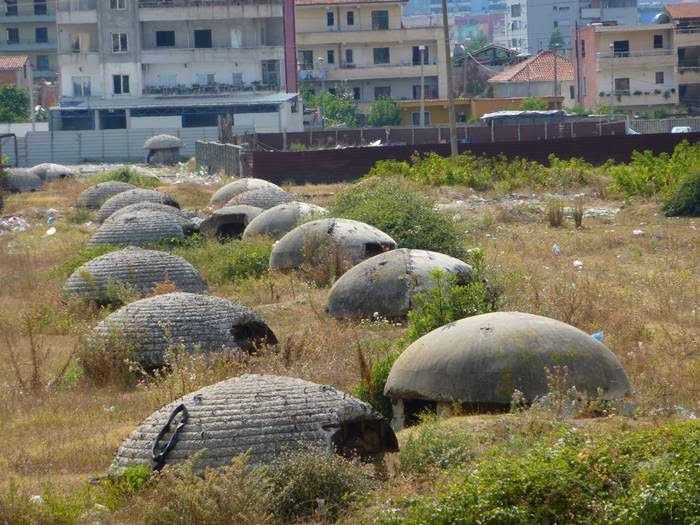
Has Trump ever seen all those zany pillboxes Enver Hoxha left scattered about Albania like a zillion mushrooms after a spring rain? There’s a couple hundred thousand of them, laid about in madcap fashion. They’re scattered across pasture land blocking each other’s field of fire. They’re in long lines just perfect for target practice. They’re set at the water’s edge, awash in the tide. The Albanians poured more concrete making those than would be in a dozen of Trump’s walls and they’re even more useless. He’d be mad with envy at the profligacy of it all. We need a zillion pillboxes, he’d say. The best pillboxes. Or maybe we can buy Albania’s. Maybe we can buy Albania. Maybe we can conquer Albania. Mussolini did.

The smell of dead potato

[Found this forgotten in the drafts folder from 2018.]

Was at Ralphs and checked out the poor people veggie bin and there were three big bundles of potatoes at 99 cents each. My Irish German heart was set aflutter and I bought all three and once home dropped them into the tuber bag with the sweet potatoes and rutabaga and onions of every color. There they sat.

A day or two later I noticed a smell. I took out the garbage. Still the smell. Took out the bag full of recyclables. Still the smell. Searched every corner and crevice of the kitchen with the broom. Sniffed the garbage disposal. Nope. Sniffed myself. Nope, just a manly deodorant. The next day the odor had grown stronger and more fetid and propinquitous. Ah ha, the paper bag root cellar where I’d put the new potatoes. Sure enough, the smell emanated from it.

I reached in and removed one of the potato bundles. They were small and red and white and blue (well, purple) and smelled like potato. The next bag was full of big honking spud beasts, huge Idaho potatoid monstrosities that taste absolutely delicious baked and topped with low fat sour cream and chopped green onions (my brunch). They too smelled like potatoes. Then the next bundle, much like the first but with the faint odor of aged brick cheese, like the time we opened a block of very aged brick cheese at a party at our place and the guests mutinied, but not then but two weeks later when either the reek or the memory of the reek lingered. That smell. I laid the bundle on the counter and carefully snipped open the netting which contained it. Then ever so gingerly I picked up each potato, sniffed it, and put it down.

Finally I got to the bottom of the pile of potatoes. There in the middle was a mid sized white potato with a sickly pallor and swollen appearance. I lightly touched it and poof! it popped open and the room was fragrant with rotten potato. It was an eye watering reek. I pulled open the windows and then took the offending spud outside and threw it into the planter. Instant mulch.

Amazing how bad that rotten potato stench is. Not sure what causes it, is it the result of the fungus digesting (so to speak) the innards of the potato, or more likely the bacteria that accompanies the fungus? Doubtless I could spend the day looking this up on Google, but I won’t. (I did later, though. It’s the bacteria.) But I did remember how Irishmen digging up their fields in the 1840’s found row after row of shriveled, mushy, foul smelling potatoes, each rotten with fungus. Doubtless they smelled like this, rank as the ripest foulest cheese, and as the potato famine spread you would have smelled that same dead potato reek across the whole island (but especially in the Gaelic speaking west and south) as peasants desperately dug up every plant looking for a potato their family could eat. A million Irishmen died in the famine that followed and the smell of dead potatoes mingled everywhere with the smell of dead people into a sickly perfume till even the roses smelled of death.

Her Majesty’s dictator legibus scribundis et rei publicae constituendae

I haven’t seen this pointed out yet, but the reason that prime minister Boris Johnson was able to suspend Parliament legally is because Great Britain is a monarchy. It’s a parliamentary monarchy, sure, but it is first and foremost a monarchy and if the monarch says sure, suspend parliament, then that is the law. The vaunted unwritten constitution of Great Britain essentially delineates what powers the democratically elected legislature has and what vestiges of absolute power are still retained by the monarchy. You just saw one. The right to suspend democratic rule.

Were Britain a constitutional republic the queen would be a tourist attraction and nothing more. But she has far more powers than the subjects—that is what they are, legally—either own up to or are aware of. And now her subjects in Great Britain are painfully aware of the scale of those powers. Why Great Britain and the Dominions of Canada, Australia and New Zealand persist in remaining officially subjects of the monarchy defies my understanding. Tradition, apparently.

And while I’m not sure how much of a bearing this had on the origins of the parliamentary rule in Britain, there’s always been distant echoes of the Roman Republic in British politics, structural echoes, as if the institutions were shaped with Roman history in mind. Certainly the scholars and aristocrats of Renaissance and Enlightenment England were steeped in Roman history, and in the original Latin. And is it a coincidence that the Roman constitution, also unwritten, allowed for the Roman legislature to be suspended in times of emergency and a dictator appointed? Results of such dictatorships were mixed for the Romans, and such appointed dictators helped hurry along the end of the Republic and the establishment of the Roman Empire. Within a few generations any pretense to democracy was shed and Romans lived under totalitarian rule. And when fascism was born in Italy after the cataclysm of the World War One it saw itself as the rebirth of Roman dictatorship and absolute rule. Mussolini fancied himself the new Caesar. He wasn’t. But ancient Rome is like a template for Europe. Or templates. There’s a Roman era for everything. But I digress.

Is Britain now finding itself in a political situation which has its roots in using parts of the Roman constitution as a model for Britain’s own? I don’t know, I just wonder, but when I heard the news that the Queen had agreed to allow the suspension of Parliament, I immediately thought of two things: the Queen nullifying an election in Australia in 1975 because she didn’t like the result, making a travesty of the democratic process, and I thought of Sulla, appointed dictator legible faciendis et reipublicae constituendae causa, that is Dictator for the making of laws and the settling of the constitution. That was in 82 BC. He retired after a year of furious change and reorganization. He fixed what was broken. Yet he set a precedent for Julius Caesar, and The Roman Republic lasted only another 37 years, when it replaced by an emperor to vast popular acclaim. Democracy died then, stone cold dead, not to revive for a thousand years.

We certainly have our own problems here is the US, but the worst of them—our president—can be taken care of by a regularly scheduled election. President Trump, were he capable of understanding the analogy, would see himself as the American Sulla, as would his followers, were they capable of understanding the analogy themselves. But unlike Sulla he flounders, a wannabe strongman but hopelessly incompetent. A buffoon. There’s no place in the American political system for a Sulla, and quite deliberately so. The men who drew up the constitution were as aware of Sulla as is Boris Johnson, who studied the classics at Oxford and can doubtless quote Roman histories in the original Latin. It’s hard to see how he doesn’t see Sulla as a role model here. The comparisons are too close. The vaunted British unwritten constitution has the influences of Roman constitutional law laced deeply within it, and that right now doesn’t seem like a good thing. It’s made this moment possible. It makes this new English Sulla possible. That can’t happen here without the US constitution being chucked out completely. But in Great Britain, as in the Roman Republic, it is laid out in the constitution itself. It is perfectly constitutional.

Has this been a profound moment in English history? Has something fundamental been shaken loose? Will there be other Sullas, ones who won’t step down after a year? Who can say. That’s a Rubicon to be crossed anon, if ever.

Scraps

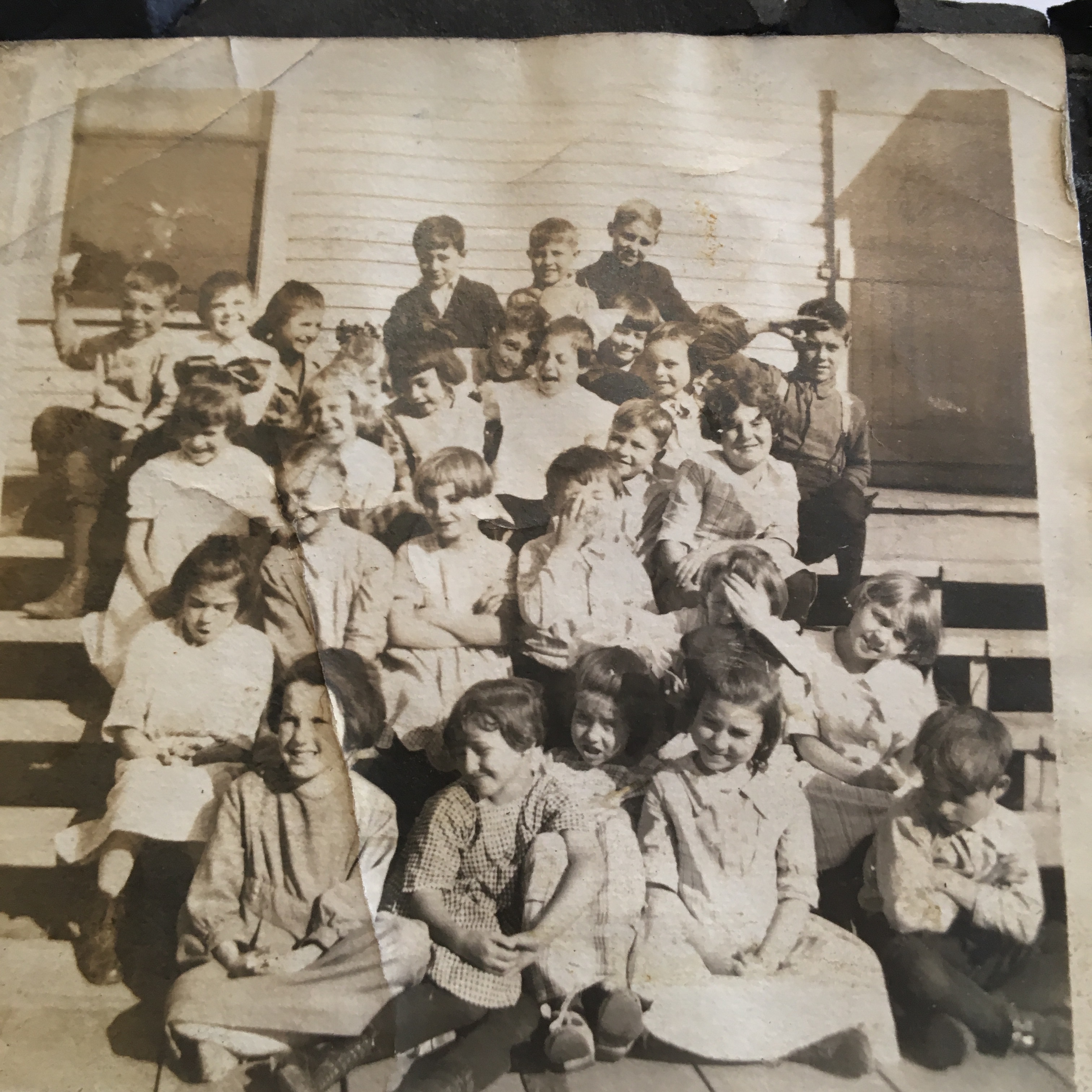
Scraps of a photo album with no one left to tell who these people are or why their pictures were pasted into a scrapbook. Like this photo. Maybe I have an uncle in there. Maybe my Dad. I can only assume it’s a bunch of immigrant’s kids in Flint, Michigan from about the Great Depression. Maybe a little before. Poor people from all over Europe, a polyglot of casts offs shook loose from the Austro-Hungarian Empire. Who knows how many languages were spoken at home. The Slovenian German my dad’s family spoke was gibberish to Germans from Germany. My grandfather forbad it and from then on it was only proper German if he was within earshot. And don’t be caught speaking English in the house.

Carl

One of the more disconcerting things about old photo albums is the tiny x’s above some of the people pictured. It means that the person had died. Well, they’re all dead now, I think, so I could put the little x’s above each and every person in each and every photo, but I won’t. It’s not done anymore. I suspect the x was actually a stylized cross—x’s usually were, if not used as the actual letter—and the slightly morbid tradition probably goes back centuries. You still see it in lists of names of military men, meaning killed in action. And you see it on old photos. The young man pictured here, a lanky teen named Carl, was my dad’s eldest brother, a terribly gifted piano player, who began with the German romantics but was caught up in ragtime and jazz. He learned those chops in speakeasies in Flint MI while still in high school, then headed for the jazz bars and swinging dancehalls in Detroit, playing for money and drink. Soon a lot more for drink than money. His father, Carl senior, loathed jazz and blamed it for his namesake’s downfall, and ordered him out of the house over and over. His mother always let him back in. He’d get picked up stinking drunk and pitched into the drunk tank. Mom would plead to bail him out. They would and the cycle repeated. Finally the old man put his foot down and said next time his son could rot in jail. Which he did, soon enough. There’s a recording he made, supposedly while in jail. It’s a Duke Ellington number, Sophisticated Lady, I think—it’s been years since I’ve heard it—and it’s a baroque swing, lush with ornamentation, a display of desperate virtuosity, sad and melancholy and unrealized. He died not much later, of DTs and pneumonia in a frigid jail cell in the depths of a Michigan winter. It was 1949, nearly a decade before I was born, and he was thirty two. The old man followed two years later, of dropsy, heartbreak, failure and his own terrible shattered dreams. The two Carls lie side by side in a forgotten cemetery outside Flint, and someone penciled a tiny x over their heads in this old photo album.

Vesti la Giubba

All three of Caruso’s first recordings of Vesti la Giubba, from 1902, 1904 and 1907, on one hit vid. All were smash hits, tho’ whether the Italian recording of 1902 or the second Victor (pre-RCA) recording were the first records to sell over a million I don’t know. You can find claims to both online. There were so many millions of each pressed in their day that even now one of these antique cylinders is worth about as much as your thrift store Tijuana Brass LPs. All three versions were pressed as cylinders, too, platters were still in the future. Though after 1913 when phonographic technology changed forever each quickly became million selling platters as well. They still sell, in fact, and somewhere spoiled rotten heirs of Enrico Caruso get richer by the day off these ancient recordings. Considering the primitive acoustic recording technology of the time—basically shouting into a megaphone, exquisitely analog—Caruso’s voice is astonishingly loud and full. Compare it with the orchestra behind him (probably literally behind him) on the 1907 recording which is so distant and compressed I mistook it momentarily for a squeezebox. My favorite of the three versions, incidentally, is the 1904 recording. It’s a tad more subtle (which might be the the first time Caruso and subtle ever occupied the same sentence) and a tad less stagey to my ears (and mind’s eye), but then that was a time that loved the stagey and overwrought, kind of like our own time, actually. Besides, it was two years before Enrico was shaken out of his wits by the San Francisco earthquake to emerge dust covered and stark naked in a paisan’s pajamas in the wreckage of the hotel lobby. Visions of Palermo a century or two earlier, leveled by a quake in the dead of night, the survivors wandering the streets dazed and nude and white with dust, ghosts in the moonlight. I wish I could remember where I read that.

But to undigress, if you remember this tune from the singing whale in the Disney cartoon you just aged yourself. Was it named Willie? There was no need to even explain it back then. Even the kids knew it was a cetacean Caruso. Have the same whale singing Stairway To Heaven today and children would know it’s a cetacean Led Zeppelin. One of those iconic things. I actually have that whale singing Vesti la Giubba here somewhere. One of those DVDs you somehow find at a truck stop. I’ll probably watch it this afternoon because you can do things like that when you’re retired. You can do it unemployed too, except when you’re retired you don’t feel guilty about it. Incidentally, any resemblance to Ronnie James Dio is coincidence. Even Rainbow In The Dark.

Somewhere in the blog there’s a story of the time we went to a now vanished pizza place in Echo Park. It had been there since these recordings were less old to them than Dark Side of The Moon or Born To Run or Saturday Night Fever are to us now. You walked in off of Sunset Blvd and instantly you were back in Jersey. Everything red vinyl, scenes of Napoli and Sicilia on the walls, a photo of Uncle Luigi in a stiff collar, fresh off the boat. Every tune on the jukebox was Italian. Dino was singing Volare as we ordered and when the pizza arrived, steaming hot, Caruso began singing Vesti la Giubba. We ate in silence, listening. Then we played it again. Sometimes little things all come together and a perfect moment is seared into your memory forever.

The wreck of the Mars

The warship Mars, the flagship of the Swedish fleet, on the floor of the Baltic where it’s lain just like this since a long forgotten battle (the first battle of Öland) in a long forgotten war with Denmark (the Northern Seven Years War) in 1564. The ship (three decks high and 300 feet from bow to stern, enormous for the time) had a crew of eight hundred (half sailors and half soldiers) and one hundred and seventy cannon and was aflame and in desperate battle with three Danish warships who were boarding her and as the decks and rigging seethed with hand to hand combat and point blank musketry the flames reached the kegs of gunpowder in the magazine below and they exploded without warning, sending the crew and the hundreds of boarders into oblivion in a scene worthy of Cecil B. DeMille. Imagine the sudden silence.

Rereading China: A History

Rereading John Keay’s China: A History which is even more mind blowing—I suppose illuminating is the bigger word for it, but same thing—than when I read it a decade ago. It’s longish, half a thousand pages and some—but almost breezily written, full of vivid details from the astonishingly complete record that Chinese written history has left us, going back almost continuously for three thousand years. I’ve never read Tolkien but I suspect that the feeling of being immersed in an alternative world packed with drama and personalities and vivid detail in a continuous narrative is the same, without the vast gaps that plague so many parts of the world where people never got around to writing anything down (as Dark Age Europe, say, or India, where they invented the science of language among so many other extraordinary things but never really got round to history.) In any case it’s the Tang Empire now halfway through the book, when China was unparalleled by anybody anywhere, a sophistication at the time (about 650 A.D. by our watches) that is almost impossible for a westerner to understand. Such is the advantage of an arc of civilization unbroken by the conquest or immersion or annihilation that befalls most civilizations, a status that lasted in China for thousands of years. And in China they wrote everything down going way, way back and in a language and writing system that didn’t become indecipherable. You don’t forget how to do things when you’ve written everything down and even if you do forget after a lapse of a couple centuries—these things can happen in the best of civilizations—you can look it up again. Technologies were not forgotten the way so much was forgotten after the Western Roman or Achaemenid Persian or Khmer or Incan empires fell (among many myriad examples.) The downside of this continuation, though, is that eventually you get hung up in your own traditions, hidebound and crotchety and unwilling to try anything new. That’s still coming up in the book, though, centuries after the Mongols invaded and killed 20 million people and wrecked everything. I’m a hundred pages and half a millennium away from that mess. Happier times ahead for now. Then collapse, reemergence, virtual annihilation, reemergence, collapse again, another invasion….eventually we get to the latest Revolution (there is a long history of such revolutions in China, nothing there is never really new) and the latest emergence. The US will probably be long gone in a thousand years, but China in some stage of its interminable gyres will still be China.

Anyway, gotta run, this new Tang emperor is getting down.