Yankton Sioux

(2013)

In the community grasslands in the middle of the Yankton Sioux reservation there is a herd of bison. We rounded a bend on the road and there they were, grazing and wandering. The land was communal and raw, wild and ancient. The grass grew high, South Dakota wild flowers were scattered about, and prairie dogs holes, and buffalo pies. We pulled the car off to the side of the road and watched the dynamics of this semi-wild herd. It was pretty sedentary that day, moving little, chewing, grazing, shaking off flies. A couple calves played tag. Vultures flew in wide circles, out of habit I guess. I doubt a bison had died and rotted there in ages, a feast for the birds. Meat’s meat and hide is hide and bones are ground into fertilizer. Vultures get by on road kill, or carcasses left as high water recedes on the banks of the Missouri.

But the sight of the herd was so completely unexpected–this was south eastern South Dakota, fenced and farmed and fertile and fallow–and probably because it was so unexpected it was utterly disorienting. We had rounded a bend and there they were. We saw a few dozen head. Did they ever stampede? I certainly hoped so. A clap of thunder and hundreds of pounding hooves headed where not even they probably knew. Just running.

It was disorienting, like the last century and a half hadn’t happened. No Sioux Rebellion in 1862. No Little Big Horn. No Sand Creek. No Wounded Knee. The Yankton missed most of these. They’d signed a treaty early. But their young men snuck off to join the other Sioux, the Rosebud in 1862, the Lakota in 1876 . My wife had two ancestors killed at Custer’s Last Stand. Though their side was the last one standing. I wonder how many ancestors she had at Little Big Horn who weren’t killed. I have no idea.

I watched the herd. It lolled about behind a farm. A nice looking farm. We’d passed a number of farms. Some of the Yankton had done well adopting western ways. But looking at the bison–the buffalo–I got the feeling that deep down these people, these Yankton, never had lost their real selves. That herd there, hidden away from outsiders in the middle of the reservation, that was their real selves. They may have signed a treaty long, long before that put them here, along the Missouri River–we’d been driving through the bottomland, which the river had inundated only a week before–but they’d cheated, and hadn’t turned white. They’d taken our names–no more Appearance of Breath or Smoke Tallow or Waiting For the Wind–but that was all, that and language and the military and taxes and watching television. Politicians came through and promised funds for the roads which never happened (you’d swear Lewis and Clark had trod that beat up asphalt). Indian kids went to concerts in the little prairie city Yankton, an hour away. But that was all. That was just the outside. Inside, the buffalo herd beat like the heart of the tribe. Breathed for the whole people. Huddled together for warmth when the cold winds blew. After all the wars and pestilence and long hikes to desolate land the Yankton had survived.

I looked at my wife in the seat next to me. She was one of them. Her mother was Oneida but her dad had been Yankton Sioux. She, her sister and her brother were the first on either side to be born off reservation. And while she had the blood of both in her veins, the DNA of each, you can’t be both tribes, not by U.S. law. So her parents signed her up as Yankton Sioux. These were her people, this her land. Those were her buffalo. And I realized that after three decades, I barely knew her. I knew her, but not all of her. I hadn’t known about that herd. To her it was the most natural thing in the world to have a communal herd of bison. It made no sense not to have one.

I wondered what else I didn’t know about her. What secrets lie inside her. What about her is still Sioux, still a tad wild, maybe, and definitely not of the white man. Native Americans are different than you or I. It’s not just that they were here before us. It’s that not everyone wears European civilization perfectly. They don it like a nice silk suit, and get by pretty much unnoticed. But left to themselves they’d shed it all, all this western civilization, at least part of the time, and get back to their dances, their hunts, their storytelling. And their buffalo, too. A big bull bison looked my way and snorted.

Sometimes I think that the Sioux think that the white man and the black man and the Mexican man and Asian man and even a lot of the other red men will just up an disappear someday. They don’t tell us this, but they think it. And when we’re not around, they talk about it, about the dancing and the hunting, and telling their stories about the buffalo. About how we came once, from across the sea and through the tall prairie grass, an innumerable host of us, and then we disappeared and were replaced again by the vast herds of buffalo, who roam with the seasons north and south and east and west. And if you stop and listen, they’ll tell their young ones, and all is quiet, you can hear the disappeared’s spirits rustling in the wind, there, but not important. Listen…and all is silent but the wind rustling the prairie grass…and that will be us, the non-Sioux people. That’s all, just the sound of the wind.

Flag of the Yankton Sioux tribe.

Anti-Pope

(2014)

A buddy posted he just landed in Avignon, France. I commented:

Say hey to the Anti-Pope for me. Well, they don’t have anti-popes anymore. So say hey to the Anti-Pope impersonator. I read a book about Avignon in the days of the Anti-Popes, come to think of it. Swinging place. Wild. Like Hollywood in the twenties. When they call it the High Medieval period, they weren’t kidding.

Then it occurred to me I’d just done a stand up routine on 14th century papal schisms. Which would not go over in the Catskills. I’ll stick to jazz criticism. Not that the audience for that is much bigger. To think I could have been a doctor. No wait…my mom was Irish. She said be a writer.

(And yes, medieval scholars, I know it is antipope (antipapa). But antipope is too much like poloponies. So we’ll stick with the hyphen.)

Clement VII, or what was left of him after blasphemous French Revolutionaries got ahold of him. He eventually took up extortion and simony--selling parishes and bishoprics to the highest bidder--to maintain his anti-papal lifestyle. You do what you gotta do.

Clement VII, or what was left of him after blasphemous French Revolutionaries got ahold of him. He eventually took up extortion and simony–selling parishes and bishoprics to the highest bidder–to maintain his anti-papal lifestyle. Ya do what ya gotta do.

.

Aztlán

I just got called a colonialist. He yelled at me about Christopher Columbus. Really angry. My people had killed off all the Indians. Proudly mestizo, he has a Spanish name and Spanish ancestors and strives to speak perfect Castilian Spanish. As for me, my father’s family was Austro-Hungarian and my mother’s family fiercely Irish and they all came through Ellis Island after 1900. They had German names and Irish names and none of them would be caught dead speaking the King’s English, not the way an English king ever spoke it. Certainly not my mother’s family, refugees from brutal English colonialism that they were.

Some ironies are best left unmentioned, I suppose. Though it would be nice if people read history once in a while. There’s a reason my denouncer has a Spanish name and Spanish ancestry and speaks perfect Castiliano. It’s not pretty.

Viva Aztlán, he said, in perfect Spanish, the final syllable reaching up to heaven.

.

Accidental Death and Dismemberment

Just looking at the dismemberment breakdown in my Accidental Death and Dismemberment policy. It’s not the kind of thing I read everyday, but still, it’s kind of entertaining in a grisly way. Losing an arm, say, or a leg is good money. Losing both is better money. Even better if the arm and leg are on different sides of the body. I remember reading in a book about the Civil War that  General John Bell Hood lost an arm on one side, a leg on the other. They had to strap him to his horse. That always seemed kind of pathetic for a big, tough Texan like John Bell Hood. I also read somewhere that he died after the war in one of those yellow fever epidemics New Orleans was notorious for. That would have been worth less money, dying from yellow fever, than losing that arm and that leg. But of course he lost that arm and that leg in a battle, well, two battles. Hood always liked to be in the thick of things. But his Accidental Death and Dismemberment policy would not have covered either amputation. Gotta read the fine print…no wars.* He should have thought about that before galloping like a fool headlong into the fray. He had to rely on veterans benefits, if they had those back then. Well they did, or would have, except he was on the losing side. No veterans benefits for them. They lost their country, their peculiar institution, and their veterans benefits. All they had left was Dixie, and you can whistle that till the cows come home and you ain’t gonna get a penny. Look before you leap, I say.

Those Accidental Death and Dismember plans–AD&D in the trade–really get into the details. You make a few bucks losing a finger or two. A thumb is a bit better, losing a hand better still. Same goes for toes and a foot. But those are still chicken feed compared to having the whole arm or leg lopped off. Losing both really does cost the insurance company an arm and a leg. They must hate that. The rep would be in the operating room, if he could, trying to sew the things back on.

The policy gets a little weird above the neck. Loss of speech, hearing, vision and maybe even smell are covered. You lose just one eye or one ear you earn some pocket change. If you lose one ear and one eye–one of those how the hell did I do that things–you get a better deal. They list all these in the policy, and all the other body parts, with the pay out for each. They run down the page in declining value. Dying is winning the Super Lotto, of course, the big wazoo of AD&D. That first D is what you aim for if considering your prospects in an accident from a strictly financial point of view. The arm/leg thing comes next, then an arm or a leg all the way down to a measly finger. You look at your finger and realize how little it’s worth. It wiggles back, showing you what it can do.

OK, this essay is getting under my skin. And that skin isn’t worth anything, insurance wise. So I’ll stop right here and leave you, dear reader, free to go watch Dexter. Personally I can’t watch Dexter. I find it disturbing and disgusting and wonder what is wrong with all you people. Then again, Dexter the serial killer is giving his victims the big wazoo, insurance wise. I doubt they’d appreciate that, however. Besides, they’re all bad guys and bad guys never have life insurance, so never mind.


* Actually John Bell Hood would have known all this too well, since he was the president of a life insurance company after the war. Imagine that. The company was ruined by the yellow fever epidemic that killed him. Killed him, his wife, a kid or two, and left a mess of orphans. Ironic now, tragic then.


.

Gavrilo Princip

[2014]

(I’m not so sure about this one…Held onto it a few months. Then figured what the hell. So here it is….)

I’ve just been reading one sad article after another about Israel and Gaza and Palestine and murders and retaliation and things blowing up.  And I’m thinking again how none of this would be happening if it hadn’t been for Gavrilo Princip and his little gun. It was a warm summer day in Sarajevo a century ago. He came out of nowhere, fired twice, killed the heir to the Hapsburg Empire and his loving wife died too. They died in each others arms.

Gavrilo Princip

Gavrilo Princip

The police grabbed Princip. He was tried, found guilty and sentenced to the maximum sentence of twenty years. There was no death penalty in Austria-Hungary for those under twenty one. Not even for regicide. He died of tuberculosis in his cell within a couple years. No matter, he was no longer any importance, none whatsoever. He never did get to see how his war came out. He just rotted his life away (literally, his tubercular bones were disintegrating) completely forgotten as the world came down all around him. He had some regrets. There are interview transcripts. He said if he’d known all this would happen he never would have shot the Archduke. Never at all. He would have stayed home deep in books–he was quite the reader–and just let the royal procession pass by. He had always wanted to be a poet anyway. A great Serbian poet.

Continue reading

Winston Churchill on funding the arts

Perhaps you’ve seen this quote lately:

When Winston Churchill was asked to cuts arts funding in favor of the war effort, he simply replied “Then what are we fighting for?”

Alas, Winston Churchill never said that. I’ve heard various accounts of how it was he never said it–one blamed Kevin Bacon because he knows everybody–but Winston never said it. He so never said it I laughed the first time I read it because it seemed so ludicrous. For one thing Churchill would have starved his own grandmother to defeat Hitler. For another almost everyone artistic was drafted into the service or being used for the war effort in one way or the other (many of the young male leads you see in British war-era films had been wounded and discharged already.) Thirdly, England was in hock so deep to the United States even before we entered the war that it eventually had to sell off its empire to pay us back, so arts funding would have meant nothing compared to, say, India. And finally I wonder if most of Britain’s arts funding already came from the aristocracy. There were enough of them. Still are.

In a country that didn’t even have enough bomb shelters for its working class population, detouring scarce funds instead into the arts would have been a travesty. Those were different times, desperate times. We can’t even conceive how desperate. We should be thankful that we can have debates about arts funding. That’s an option of civilizations not facing annihilation.

However, Winston Churchill did once say that a man who blew the trumpet for his living would be glad to play the violin for his amusement. And I have never been able to figure out what the hell that means. But he was a painter, and you how they are.

Decline and Fall

This is end times, someone wrote. Yeah, a friend wrote back, it’s like the fall of the Roman Empire. You hear that a lot, how we are declining like Rome. As if Roman history as Edward Gibbon described it in The Decline and Fall of the Roman Empire were a template that all afterward must follow. But the United States has existed only 250 years. 250 years seems like a long time, a quarter of a millennium, ten generations, four lifetimes. Someone born, say, in 1766–old enough to remember the Declaration of Independence, the twenty gun salutes, the parades and the war–could die at 1826. His grandkids born in 1816–old enough to remember grandpa, could live till, say 1876. His ten year old great grandson, born in 1866 (and imagine how dramatically different the county was, and suddenly, in 1866) could live easily till 1926. 1936 even. His great-great grandson, born in 1926, could have had a son born in 1957 (making him the great-great-great grandson) and a grandson (the great-great-great-great grandson) born in 1986. That’s a lot of great-greats. But not so many that you can’t imagine the continuum of relationships between them. It’s not that far back to your great grandfather and then to his great grandfather, the one who witnessed the American Revolution. The extent of American history can be expressed in a just a few relatives, a brief string of grandfathers.

That seems a long time. But Rome lasted ten times as long. The kingdom of Rome lasted a couple hundred years, and then the Roman Republic lasted from about 500 BC to 27 BC, and the Western Empire till 476, and the Eastern empire till 1453, you’re talking twenty two, maybe twenty three centuries of continuous existence. That is grandfathers out to the nth degree. And it’s there, for me, that the decline of the Roman Empire template doesn’t work for the U.S. We have not been here long enough to have any sort of decline on a Roman scale. Comparisons between the U.S. and the Rome are just trite exposition devices, clichés. Very few states and/or civilizations have had the sort of longevity that Rome had. Egypt was one, ending as an independent kingdom after maybe three thousand years, lasting as a distinct civilization another thousand years, and as a culture since. China remains another, endless cycles of concentrated imperial power and chaos and a civilization that remains distinctly Chinese for four thousand years. As does Iran–something few people outside Iran realize is that Persian civilization has stood in a continuous arc now for 2700 years (though if you include the Elamites it goes back twice that). To Iranians we Americans are just the latest in an endless line of enemies, all of whom they have thus far outlasted. They feel sure they will outlive us too. From our perspective now it seems utterly absurd to think that they will long survive us. But if the historical record is any guide, they probably will. They will be here, and so will China. Then again, we might be here too. Just because we got such a late start doesn’t mean we may not be here two or three thousand years hence. It’s just that very few civilizations have managed to last intact that long. Something generally happens and they fade away or dissolve or vanish completely in a bloody instant. Half-lifes remain, echoes, in a language, religion, mythology, even cuisine. And sometimes nothing remains at all but ruins. I wonder if anything at all remains of the ways of the people who lived in many of those ruins in Mesopotamia, memes we don’t even recognize as memes. If so, memes must litter the Fertile Crescent like shards of glass. People doing things because people did those things five thousand years ago, in long dead languages. A half dozen of this, a dozen of that we think, babylonically.

Gleaning my well thumbed copy of Gibbon’s Decline and Fall again to see into our own future is a futile exercise, of course, turning history into science fiction. I’ve done the same with Thucydides. I get no answers, just vague suppositions. Who knows what the fate of American civilization will eventually be. Maybe something entirely new. Perhaps we’ll be hacked into non-existence, control-alt-delete and zap.

An earlier border wall.

An earlier border wall.


Tokyo Rose

[2014. The offending list has since disappeared, incidentally.]

Sometimes you see something on the web that really bothers you. There was a time when you’d leave a comment, but comments sections are now sewers of hate and confusion and paranoia and worthless for anything but outrage and craziness. So instead you find out who’s in charge and send them an email, and more often than not the guy in charge reads it. So after seeing something I thought was totally wrong and unfair in an idiotic bit of clickbait on Answers.com, I emailed David Karandish, the CEO of Answers.com, and said this:

I know in the grand scheme of things it means nothing, but the answers.com piece 9 Notorious Traitors in History lists Iva Toguri D’Aquino aka Tokyo Rose in its sixth spot, between the fairly loathsome creatures Ezra Pound and Vidkun Quisling. Alas, it is a well known if tragic tale that D’Aquino was not only not a traitor but her treason trial was a travesty and she received a full presidential pardon in 1976. Even a cursory reading of her Wikipedia entry would have shown this, this paragraph in particular:

On January 15, 2006, the World War II Veterans Committee (sponsors of the Memorial Day Parade in Washington D.C. and the National World War II Memorial, the newest monument on the National Mall, citing “her indomitable spirit, love of country, and the example of courage she has given her fellow Americans”, awarded Toguri its annual Edward J. Herlihy Citizenship Award. According to one biographer, Toguri found it the most memorable day of her life.

As I said, in the grand scheme it means nothing, and I understand the pressures of coming up with content and clickbait and just how ephemeral this all is anyway, but still a couple ten thousand people who read your site’s essay will learn, again, that Tokyo Rose was a traitor. There was a time when history a few generations old was the realm of scholars, but no more. Now it’s in the hands of interns and amateurs and smartasses.

 Brick

That was it. It means nothing, does nothing, matters not a bit. I know that. In fact it was a waste of a half hour and we only get so many half hours in life. But it made me feel a little better.
Iva Toguri served six years for treason, and was later pardoned by President Gerald Ford. Ford had served in the Pacific in the war, and had probably listened to Tokyo Rose every day.

Iva Toguri served six years for treason, and was later pardoned by President Gerald Ford. Ford had served in the Pacific in the war, and had probably listened to Tokyo Rose every day.

Collaboration

I think when English and Americans condemn France for its collaboration in World War 2–and I am not justifying the craven Vichy government–they forget one key point about themselves. And that is that unlike Britain and the USA, France was conquered, occupied, and then left in part a puppet state, a succession of events which they had no control over once the Germans had flanked their armies and left Paris, and France itself, essentially defenseless.  A simple miscalculation by the French high command–they had placed the left wing of their army, with most of their armored forces, too far forward to respond to the German blitz through the Ardennes–brought about military collapse. It was sudden and complete, even more sudden and complete than the defeat in 1871, and completely opposite the brutal slog of 1914-18. War like this didn’t even seem possible. The French–the government, the press, the labor leaders, the armed forces, the population–were stunned into cowed acquiescence. Cleverly, their Nazi conquerors offered employment and a future to all kinds of French citizens. The French were now subjects with a stake in the future of the Third Reich, a status not granted to the citizens of Poland, etc., who faced extermination by murder or starvation or endless chattel slavery.

The German occupation was helped along immeasurably by the presence of a very large pre-war fascist and extreme rightist movement in France. This was true across large parts of Europe (even the neutral Swiss arrested their own Nazi sympathizers just in case). These homegrown fascists were more than willing to take up leadership, administrative and policing roles in both Vichy France and German occupied France, as well as throughout the French colonial empire. It’s hard not to think of these French collaborators with a visceral disgust, even seventy five years later. Yet we’ve almost forgotten that there were fascist elements–and Stalinist elements–in Britain as well ready to take their place in their own Nazi occupation government should it come to be. Had Hitler’s planned Operation Sea Lion somehow succeeded in crossing the English Channel there can be little doubt that the virtually disarmed Britain (with nearly all the Royal Army’s equipment–cannon, tanks, machine guns, etc.–abandoned at Dunkirk) would have been conquered as easily as France. And that there would have been some degree of collaboration with Nazi occupation authorities in England (remember the film It Happened Here?) Would there have been the same degree of collaboration as in France? Hard to tell. The fascist movement was smaller in England, but it was not insignificant. Indeed, it included the former King Edward, then living in France as the Duke of Windsor, and who was quite chummy with Adolf Hitler as late as 1939. (The Nazis had big plans for Edward, but the British spirited him away to the Bahamas before the panzers reached him.) In France the suddenness of defeat made fascism seem irresistible, inevitable. It’s hard to see why England would have reacted any differently. And it’s not like the English would have had much choice. To refuse to collaborate was often the last decision one ever made.

For argument’s sake, and strictly theoretically speaking, let’s also assume that had Britain or France somehow been occupied by the Soviet Union, as were the Baltic States and eastern Poland in 1939, there would have been no shortage of collaborators either. The NKVD (Stalin’s vast secret police organization) had no problem finding local Poles, Lithuanians, Latvians and Estonians to work for the Soviet occupation–even as the same NKVD was arresting, torturing, imprisoning, exiling or executing hundreds of thousands of the collaborators’ countrymen. Hitler or Stalin, it did not matter, there were quite literally millions of civilians, police and military the breadth of occupied Europe willing to join up (there were half a million “Germanic non-Germans” in the Waffen SS alone, though many of those were conscripts, and perhaps a million Russians assisted the Wehrmacht as soldiers or auxiliaries, if only to avoid starvation as prisoners of war). Had the US somehow been conquered by Hitler or Stalin there would have been no shortage of collaborators here either. It might seem immoral, ludicrous and inconceivable now, but in the 1930’s both fascism and Stalinist communism were seen as legitimate ideologies by a remarkable number of people. That became clear when the Spanish Civil War erupted and the intelligentsia and artistic communities across the western world began splitting into two camps. I am not sure now which side had more supporters, even in the U.S. In Hollywood there were rallies and star studded fundraisers on behalf of the fascists. Though it wasn’t so much fascism that drew these people, but anti-communism. By this point communism–then still more widely known as bolshevism–had terrified many. Remember that this was during Stalin’s purges and show trials, and after the appallingly brutal famine in the Ukraine (the Holodomor.) Bolshevism was not revolution like our own genteel (or so we remember it) American Revolution. This was a French Revolution gone utterly mad and evil. Thus Franco, wrapping himself in the anti-communist banner, received a surprising amount of support even among western intellectuals and bohemians, far more than we care to remember now. I mean Gertrude Stein? J.R.R. Tolkien?

On the other hand, the Spanish Republic’s supporters splintered immediately into liberals and socialists on the one hand and an ardent Stalinist bloc that in Spain actually purged the non-Stalinist Republicans, executing hundreds, sometimes right in the front lines. Stalin’s paranoia had an incredibly long reach. It is forgotten now that George Orwell himself, the voice in English of the anti-fascist Republican cause, barely escaped such an execution in Barcelona. Agents came to his hotel looking for he and his wife. They escaped to France, but just barely. (The film Land and Freedom vividly shows some of this madness.) Fascism, on the other hand, had an almost universal solidarity, it was a mailed fist. Meanwhile, and tragically, anti-fascism was splintering into every faction imaginable, and the hard line Stalinists saw everyone else on the left as an enemy to be subverted or destroyed before Stalin got around to defeating fascism. (In fact, Stalin’s plans to launch a surprise assault on Nazi Germany were sidelined by his decision to purge, torture and execute nearly all his generals instead.) Spain became a microcosm of what the rest of Europe would be in the 1940’s, with Nazis and locals willing to serve them, and Stalin’s agents and those willing to serve them. Somehow, though, both Hitler and Stalin failed to make permanent inroads in Spain. Although a division of Spanish volunteers served on the Russian Front–and after Franco withdrew them, a core of 3000 Spanish fascist fanatics refused to leave, fighting till the war’s end– Franco retained his independence and his nation’s neutrality, and the Spanish communists, once Franco was gone, became genuine democratic socialists. Unfortunately you can’t say the same for the rest of Europe. Fascism was ended only by Germany’s military defeat, otherwise it might still in charge now. And Stalinism–though somewhat mellowed with age– fell only when the Soviet Union imploded through economic failure. Neither showed any sign of ever going away on its own. There was a limitless supply of people in every occupied state willing to do their German or Russian master’s bidding, even if it meant shooting down their own kind in cold blood.

It’s as if the raw material of collaboration was there throughout the Western world just waiting for its moment. My father remembered being taken to beer halls when he was a boy by his father. The rooms were draped with Nazi flags and people listened to Hitler’s speeches on the shortwave and cheered lustily–and this was in Detroit, Michigan in 1940. In Europe of course it was far worse. Switzerland had to arrest politicians and military men who actively supported Hitler (though the head of the Nazi Party in Switzerland was assassinated by a Croatian Jew in Davos in 1936 in a rare and prescient act of resistance), while both Hungary and Romania were spared conquest by the Nazis because homegrown fascist movements had taken over the government. The cost of the more honorable alternative of resisting the Third Reich was all too vividly shown by Yugoslavia, which suffered through four years of appalling warfare and murderous oppression that killed nearly ten per cent of the pre-war population.

Collaboration made far too much sense for most people at the time. It would today as well. The Polish resistance–the Home Army–was 400,000 strong in 1944. The French resistance (before the Allies landed) had one quarter of that. France had a larger population than Poland and had one twelfth of the civilian losses of Poland. But the Germans had forbad Polish collaboration. The Poles were left with no alternative but resistance. If they were caught they were almost invariably killed, but they were going to starve or be worked to death anyway. But the French could choose to collaborate actively (by assisting the regime) or passively (by not assisting the resistance). In not resisting you would survive, perhaps even thrive. Your family would eat. Joining the resistance meant a strong likelihood of torture and/or death, perhaps extended to your family members and friends and neighbors. So most passively collaborated. It was the logical choice, collaboration. They had to think about their families. I am not being sarcastic here. Passive collaboration was the genuine logical choice for most Frenchmen. In terms of taking care of their own, it was the correct thing to do.

Unlike Britain, the USA or Switzerland, France had the misfortune to be conquered, and then the fortune to be handled fairly lightly by the Reich. The Danes, good Aryans that they were even if they despised the Germans, were occupied with even a lighter touch (while spiriting almost 100% of their Jews into Sweden and out of the reach of the Holocaust), but the French (the non-Jewish French, anyway) still did extremely well compared with the genocide against the Slavic Poles. It was the relatively mellow German occupation in France made collaboration possible. Even had a Polish fascist (and there were plenty of them pre-war) wanted to join the Nazis as so many French citizens did after the surrender in May of 1940, he wouldn’t have been accepted. (Recall Sophie’s Choice where Sophie’s father was a Polish fascist, yet she still was sent to a death camp.) Besides, the Nazis went through and slaughtered the Polish intelligentsia early in the occupation, thus in one stroke sparing Poland discussions like those about French collaborationist guilt. (As for their guilt in the Holocaust, that is another matter). But any Célines there may have been in the literary salons of Warsaw were quickly executed by the Nazi occupation authorities along side the patriots.

We can condemn the French–and all the other nationalities too–for collaborating. And we should. But we should also keep in mind that our own compatriots would have acted no better in the same circumstances. With a breath of fascism in the breeze today, it’ll be interesting to watch how people collaborate these next couple months of 2016 in the United States. We will be surprised, I suspect, at who switches sides, and how fast, and without blinking an eye.

Frankreich, Milizionär bewacht Widerstandskämpfer

A member of the French Milice (the Vichy military police) guarding captured (or arrested) members of the French resistance, June 21, 1944. Note the Hitler mustache….

Stalin on the phone

(2005)

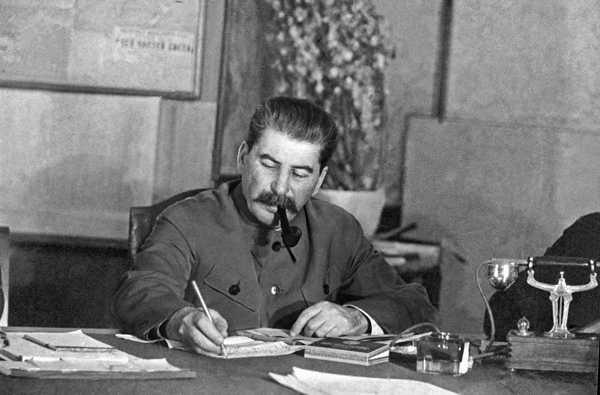
It occurred to me several years ago [back in the 1990’s] that Stalinist Russia would have been an impossibility without the telephone. A call is made, a man arrested. Another call is made, the man is shot. Bureaucratic terror emanating via phone lines. There were mailed instructions, of course, and couriers, and telegrams. But a phone added a voice. You hear Beria on the phone and you respond instantly. The phone gave immediacy, extending Stalin’s absolute power the length and breadth of Russia because he could order–or his minions could order–an arrest or execution instantly and personally. There could be no delay. No dissembling. No shuffling of papers or death sentences lost in the mail. Not that things weren’t shuffled or lost in the mail. But doing so risked the wrath of someone higher up and a phone call. A phone call to you. Or a phone call to someone about you. Death and terror whisked across the Soviet Union in fractions of a second. I wonder if, during the height of Stalin’s purges in the 1930’s (when a million at least were shot, and ten million sent to the Gulag), people stared in dread at a ringing telephone, knowing they had to answer, and if it would be the last time.

But now I wonder if such a vast purge would have been an impossibility with the answering machine. I mean, if no one is there to hear the command, will it be obeyed? Stalin’s calls would be answered, of course. And Beria’s. But down the line, an assistant of an assistant of an assistant people’s director of security, would their calls be answered? Arrests and executions piling up unheard on feebly blinking answering machines, or perhaps heard but unacknowledged, allowing warnings and escapes. Oh how we hate leaving messages. Imagine then Stalin, leaving a message after the tone.

stalin-phone

Stalin at his desk at the height of the Purge. His phone is a remarkable decadent thing, thoroughly bourgeoisie, a contrast with the massive black utilitarian phones that appear on his desk in all the museum replicas.